How Does Modular or Flexible Conference Room Furniture Improve Adaptability of Meeting Room Tables?
A meeting room rarely serves a single purpose throughout the working day. One session may involve a formal presentation, while the next requires small-group discussions or collaborative planning. Such changes place different demands on table arrangements, available workspace, and access to technology.
Flexible conference room furniture allows businesses to adjust these elements according to the activity taking place. Leadcom Seating reflects the practical considerations involved in workplace furniture design, where adaptability depends not only on movable components but also on how individual pieces accommodate changing professional needs.
Reconfigurable Layouts for Different Meeting Formats
The arrangement of meeting tables influences how participants communicate and distribute their attention. A traditional boardroom layout places attendees around a central surface, making it suitable for management discussions and formal decision-making. However, this configuration may not provide the same level of interaction required during workshops or brainstorming sessions.
Modular tables introduce more possibilities by allowing individual units to be rearranged. Several smaller tables can form a continuous conference surface, while separate clusters create dedicated spaces for group activities. This approach makes it easier to accommodate different participant numbers without assigning an entirely different room to every meeting type.
Room dimensions should also influence configuration decisions. Folding, nesting, or independently movable tables can help release floor space when a meeting requires fewer workstations. With appropriately selected conference room furniture, the same environment can support presentations, training sessions, and collaborative projects through relatively simple layout adjustments.
Integrated Features That Support Changing Work Requirements
Physical flexibility represents only one aspect of an adaptable meeting environment. Modern workplaces also require tables to accommodate laptops, charging devices, presentation equipment, and other digital tools. Furniture with integrated connectivity features can reduce the need for temporary wiring arrangements whenever the meeting format changes.
Power access deserves particular attention in shared spaces. Flip-top outlets provide a convenient way to access electrical connections directly from the tabletop, while keeping power components covered when they are not in use. Their positioning should account for participant seating, cable reach, and the equipment commonly used during meetings.
Table construction also affects how well these features fit into the overall design. A sufficiently thick tabletop can accommodate integrated components, while an appropriately engineered support structure provides stability around areas containing electrical fittings. These details help conference room furniture respond to practical workplace requirements rather than functioning solely as a collection of movable surfaces.
Modular Construction and the Relationship Between Components
Adaptable furniture depends on how individual components work together. Tabletop dimensions, connection points, supporting beams, and edge treatments all influence whether different units can be arranged consistently. Standardized dimensions are particularly useful when several tables need to form a larger working surface.
Material selection contributes to this relationship as well. E0-grade particle board with a melamine finish is commonly used in office furniture because it provides a practical surface for routine workplace activities. PVC edge banding adds protection along exposed tabletop edges and creates a finished boundary around the board.
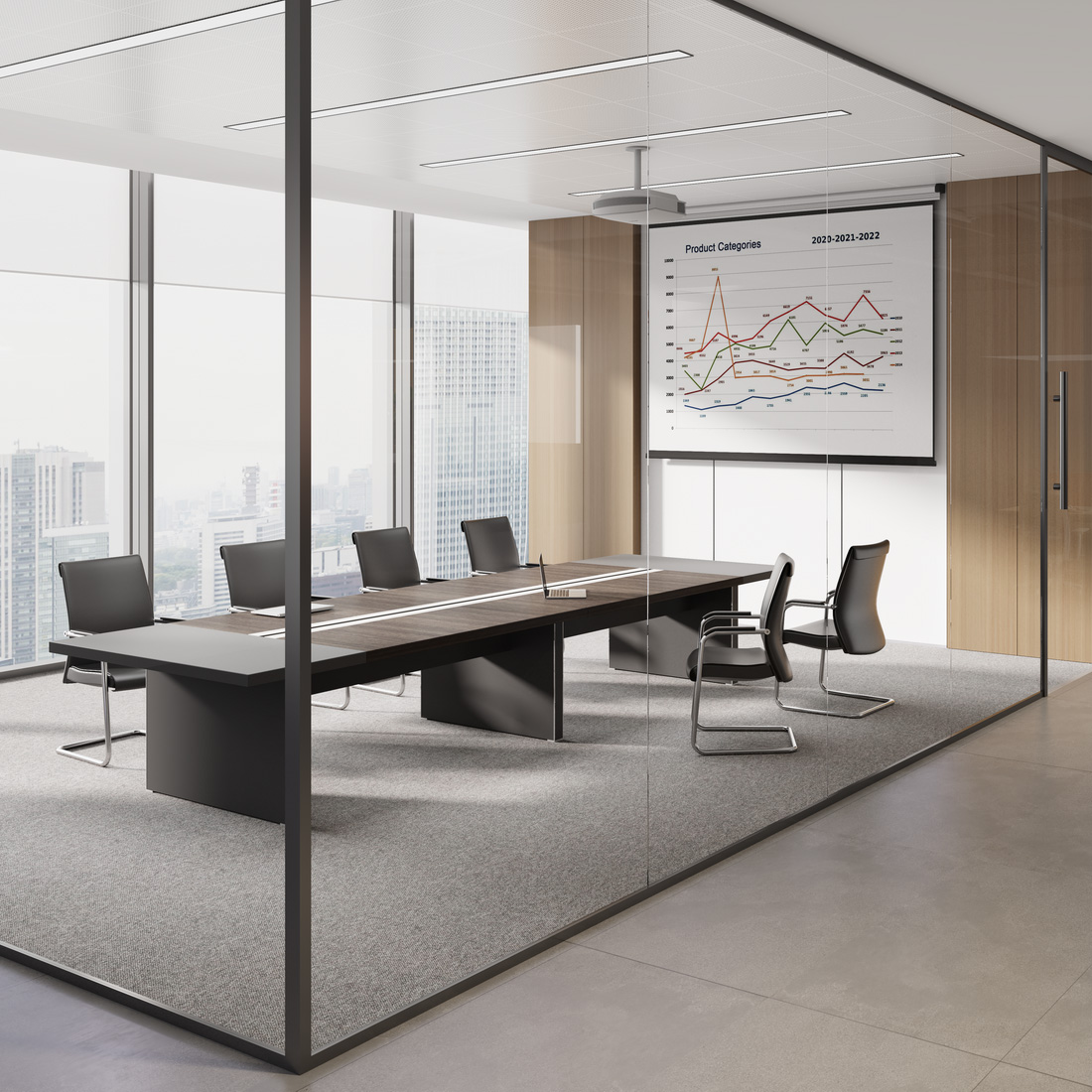
The NOVA meeting table #31 from Leadcom Seating illustrates how these construction considerations can be incorporated into a fixed table design. It features a 50 mm thick E0-grade particle board tabletop with a melamine finish, PVC edge banding, and a flip-top power outlet. Its under-desk beam uses 38 × 38 × 1.2 mm heavy-duty cold-rolled steel, providing structural support while leaving the tabletop available for everyday meeting activities.
Space Planning for Long-Term Workplace Adaptability
A flexible meeting environment requires more than furniture that can be moved around. Space planners need to consider circulation routes, storage locations, chair clearance, and access to shared equipment before establishing a layout. Without sufficient planning, frequent rearrangement may create congestion or make certain seating positions difficult to access.
Storage is another factor that can influence the practicality of modular arrangements. Tables that can be nested or stored in designated areas allow rooms to transition between different functions more easily. Storage dimensions, movement paths, and the availability of handling space should all be considered during the initial planning stage.
The expected frequency of layout changes also matters. Training facilities and multipurpose conference rooms may require regular reconfiguration, whereas executive meeting spaces often retain a relatively stable arrangement. Selecting conference room furniture according to actual usage patterns helps avoid unnecessary complexity while preserving the flexibility that different activities demand.
Conclusion
Adaptability in meeting spaces comes from the interaction between furniture configuration, structural design, technology access, and spatial planning. Modular arrangements provide different ways to organize participants, while integrated power features accommodate the growing use of digital equipment. Material specifications and supporting components also influence how effectively individual tables function within a shared environment.
Leadcom Seating demonstrates how practical construction details can contribute to workplace table design. Businesses evaluating meeting environments benefit from looking beyond the initial arrangement and considering how furniture will perform across different activities and room configurations. A well-planned conference room furniture arrangement gives organizations greater freedom to reshape their meeting spaces as communication methods and operational requirements evolve.


