Nylon Hose for Automotive Turbocharger Systems: How Boost Pressure and Temperature Shape Hose Design
Turbocharged engines depend on reliable charge-air delivery to convert compressed air into usable power, yet the path between the turbocharger, intercooler, and intake manifold exposes connecting components to demanding conditions. A nylon hose must tolerate pressure fluctuations, substantial temperature changes, and vibration without losing dimensional stability or developing leaks.
Its performance depends on more than the nominal pressure rating: polymer characteristics, wall construction, connection design, and validation under realistic operating cycles all influence service life. DEKUMA operates in the polymer extrusion machinery sector, where understanding these requirements helps explain how multilayer tubing is manufactured for demanding automotive applications.
Managing Boost Pressure and Structural Stress
Boost pressure creates sustained stress across the hose wall, while acceleration and throttle changes introduce rapid fluctuations. Under these conditions, the material must resist expansion, creep, and fatigue. A pressure rating measured under steady laboratory conditions may not fully represent repeated boost events, especially when elevated temperatures soften the polymer or increase its tendency to deform. Engineers need to consider both normal operating pressure and transient peaks when specifying tubing for a particular engine platform.
Wall thickness plays a central role in pressure resistance, but simply increasing it is not always the best solution. A thicker wall can improve resistance to deformation, yet it may also increase mass, restrict routing flexibility, and place greater loads on adjacent fittings. The appropriate dimension depends on tube diameter, material modulus, temperature exposure, and the pressure differential expected during operation. Design calculations should be supported by testing rather than relying on a single dimensional rule.
Layered construction offers another way to balance competing requirements. A composite tube can use different polymer layers to provide structural support, environmental resistance, or compatibility with the conveyed medium. However, the layers must remain bonded through pressure changes and thermal expansion. Weak interfaces can permit separation or localized deformation, so material compatibility and process control are important alongside the nominal strength of each individual layer.
Accounting for Thermal Cycling and Engine-Bay Conditions
Compressed air heats as the turbocharger raises its pressure, while an intercooler reduces charge-air temperature before the air enters the engine. Actual temperatures vary with engine load, ambient conditions, cooling efficiency, and vehicle packaging. A hose positioned near hot engine components may experience additional radiant and conducted heat, even if the air passing through it is relatively cool. Material selection should reflect both internal fluid temperature and the surrounding environment.
Repeated heating and cooling can gradually change polymer dimensions and mechanical properties. Expansion during hot operation followed by contraction during cooldown places stress on connections, clamps, and interfaces between dissimilar materials. If the selected polymer loses stiffness at elevated temperatures or becomes less tolerant of repeated deformation, a connection that initially appears secure may develop leakage after extended cycling. Temperature limits should consequently be evaluated in conjunction with pressure and installation conditions.
Chemical exposure also matters. Engine oil mist, fuel vapour, cleaning agents, and road contaminants may contact the outer surface or enter through imperfect connections. Resistance varies by polymer grade and formulation, so a material suitable for one engine compartment may not perform equally well in another. A nylon hose specification should account for relevant fluids, temperature-dependent resistance, and expected exposure duration rather than relying solely on a generic description of nylon as a durable engineering plastic.
Evaluating Vibration, Routing, and Qualification Tests
Engine movement and road inputs impose mechanical loads that static pressure tests cannot reproduce. Turbocharger plumbing may vibrate at several frequencies, while engine torque reaction shifts the position of connected components. If the hose is routed too tightly, bending stress can concentrate near a fitting or clamp. Adequate clearance, suitable bend radii, and controlled support points help limit these loads without restricting movement needed during normal operation.
Qualification testing should represent the component’s expected duty cycle. Pressure impulse testing can assess how the assembly responds to repeated pressure changes, while thermal cycling reveals dimensional changes and weakness at joints. Vibration tests can expose fretting, abrasion, fitting movement, or fatigue around mounting points. Combined-condition tests may be especially useful because pressure, heat, and vibration can interact in ways that separate tests do not reveal.
Inspection criteria should extend beyond visible rupture. Permanent diameter growth, surface cracking, layer separation, leakage, and changes in flexibility may indicate that a component is approaching its functional limit. For a composite tube, testing should also examine the integrity of layer bonding after exposure to heat and cyclic loading. The number and severity of test cycles should reflect the vehicle’s intended use, including high-load acceleration, repeated stop-and-go driving, and prolonged operation at elevated engine output.
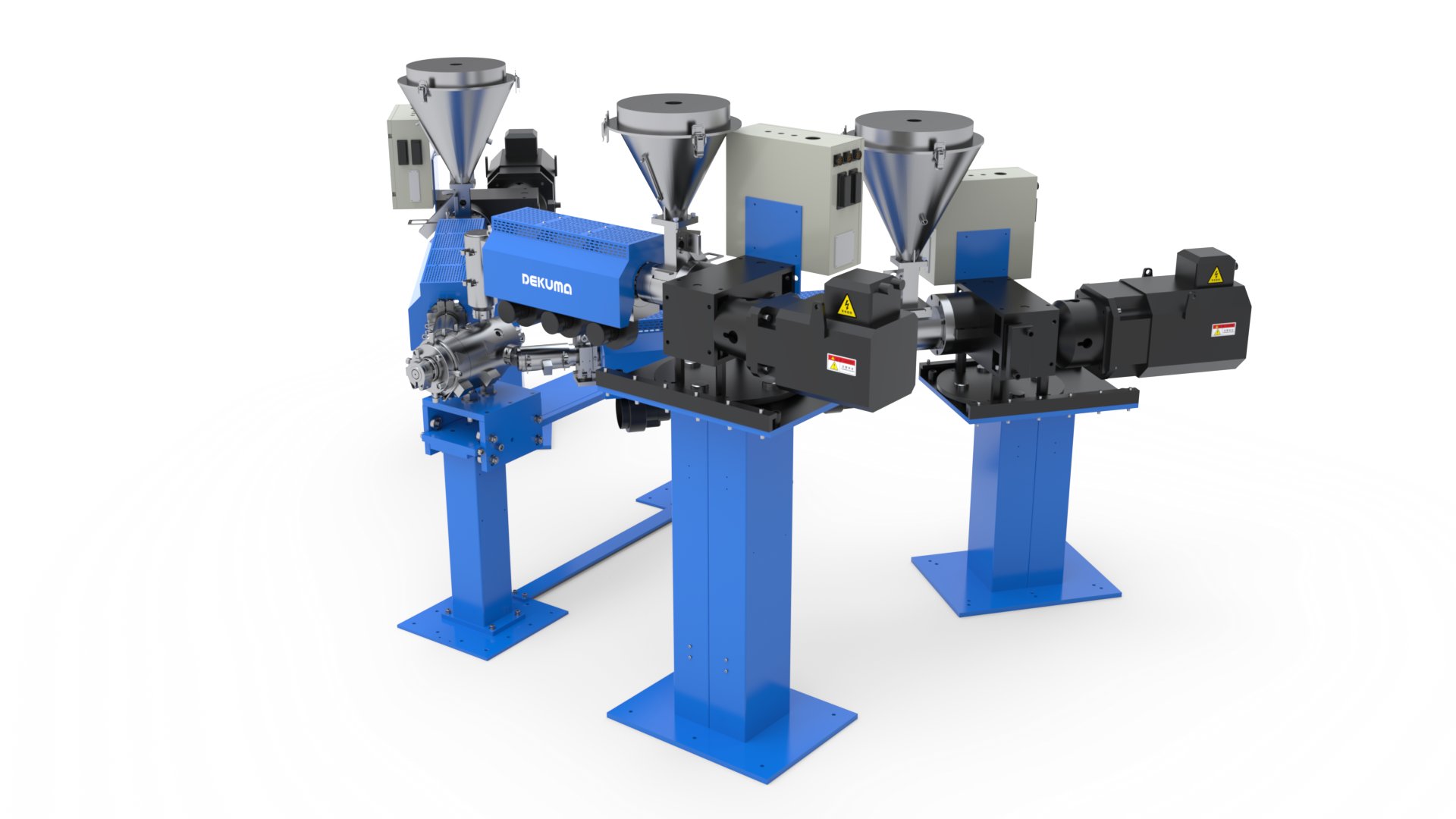
Manufacturing consistency is another factor in qualification. DEKUMA’s Multi-layer Nylon Composite Tube Extrusion Line uses three extruders to form the outer, middle, and inner layers, with a maximum extrusion output of 50 kg/h. Its spiral extrusion die head is designed for multilayer pipe production, features ceramic heating with a maximum temperature of 300°C, and incorporates an adjustable die-to-core gap. These features are relevant to controlling layer formation and dimensional consistency, although the suitability of any finished tube still depends on its material specification and application-specific validation.
Conclusion
Reliable turbocharger plumbing results from matching material properties and geometry to the actual combination of pressure, heat, and mechanical movement found in service. A well-specified nylon hose needs adequate pressure capacity at operating temperature, suitable flexibility for its installation path, and resistance to the fluids and environmental conditions it may encounter.
Qualification should reproduce meaningful aspects of the engine’s duty cycle and assess both immediate failures and gradual degradation. By connecting extrusion process control with application-based testing, DEKUMA provides a useful manufacturing context for understanding how multilayer tubing is produced. The Final performance remains dependent on validated design, materials, and assembly quality.